

While the American Revolution dragged on in the colonies outside New York, the city itself was occupied by the British Army. The occupation, starting from late 1776, lasted to late 1783, a full two years after the British surrender at Yorktown in Virginia.
To effect control of New York City, the British sent a literal armada to the place — 421 ships, the largest amphibious invasion before World War II. They aimed to capture this strategic port (and the Hudson River), then grab more turf in order to cut the 13 colonies in half and end the rebellion.
They were close to success within a couple of months after the Declaration of Independence was signed. America’s history could have been very different.
‘The Occupied City’
New York’s experience is the centerpiece of an exhibit called “The Occupied City” at the Museum of the City of New York located on Manhattan’s Fifth Avenue. The museum set aside an entire floor (7,000 square feet) for the show, divided into six segments, each devoted to a different time frame, ranging from a pre-war era of rising dissatisfaction with British polices to the earliest post-war years when New York was the nation’s first capital.
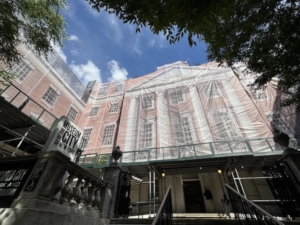
Exterior of the Museum of the City of New York, site of“The Occupied City” exhibition, open through May 1, 2027. The scaffolding, reflecting repair and restoration work on the exterior, has no effect on visits.
This show is in walking distance of my apartment. I went, partly because I am interested in the story and partly because museum exhibits always deliver a few surprises.
Surprise No. 1: New York City was so divided between patriots and loyalists that, the show’s signage says, “it was not certain that New York would join the new nation.” News to me.
Early in the exhibit, visitors are invited to grab a questionnaire and answer four key yes-or-no questions to determine if they might have been 18th century revolutionaries or loyalists, or something in between.
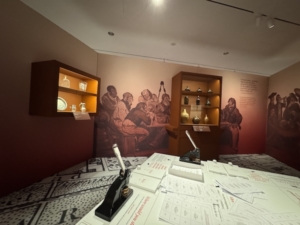
A separate room in “The Occupied City” exhibit set aside for tantalizing reflection. We, as visitors, are invited to fill out a questionnaire. Results purport to determine if we might have been revolutionaries or loyalists.
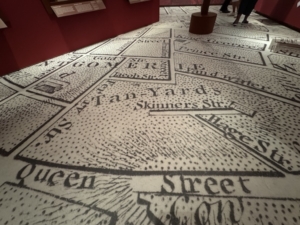
Parts of an old map of New York’s Manhattan seen on the floor of “The Occupied City” exhibition at the Museum of New York City.
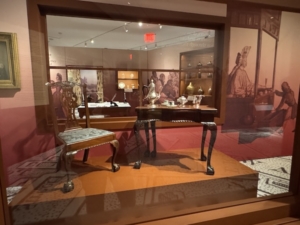
A simulated coffeehouse meant to imitate one type of establishment in Revolutionary Era New York City where locals would gather to do business and debate the future.
In the mid-1770s, New York’s revolutionaries were many and vocal; taverns and the waterfront were centers of rebel discontent. On July 9, 1776, after the first public reading in the city of the Declaration of Independence, excited soldiers and sailors pulled down a statue of King George III, which had stood in Bowling Green. The green is a tiny spot of geography popular now with tourists because of the sculpture called “Charging Bull” or the “Bull of Wall Street.”
The museum exhibit includes a painting depicting a tumbling King George III, but for a bit of fun, museum goers are invited to (digitally) pull down the king themselves.
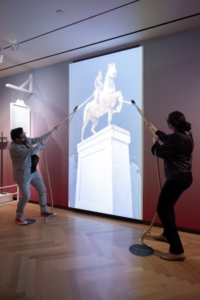
An interactive feature in “The Occupied City” exhibit at the Museum of the City of New York. On July 9, 1776, soldiers and sailors toppled a statue of King George III, located in Bowling Green. That act has inspired numerous traditional artworks, but in this case, visitors are provided physical ropes in order to “topple” a digital statue. Photo by Filip Wolak.
Tough times
It wasn’t long, however, before things got really serious. The Aug. 27 Battle of Brooklyn — the largest of the Revolutionary War — was a catastrophe. The only good news for colonists was the nighttime evacuation of most of the Continental Army from Brooklyn to Manhattan. If the army had been captured, the revolution could have ended on the spot.
Before year’s end, colonial forces had retreated from all of New York City. The revolutionaries made their last stand here in November at the Battle of Fort Washington. A small sculpture of a woman manning a cannon visualizes the true story of Margaret Corbin, who like many wives was a camp follower. She jumped into the action after her husband and many others had been killed. She was badly wounded and later received a pension, the first woman to be recognized for U.S. military service.
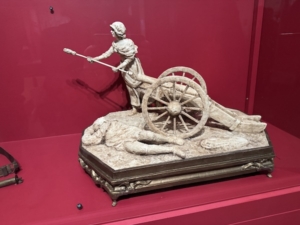
Small new (2025) sculpture of Margaret Corbin, envisioning her as she takes over a cannon to compensate for the deaths of numerous men during the Battle of Fort Washington in November 1776 in New York’s Upper Manhattan.
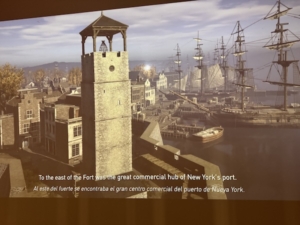
Visitors learn or are reminded of another bit of misery; in September 1776, someone set fire to a large swath of Lower Manhattan. One of “The Occupied City’s” most effective components is a video reconstruction of how the burned-out neighborhood might have looked, including a striking visual of a hallowed-out Trinity Church. The film was adapted from material created for the “Assassin’s Creed” video game series. The video feels like a fast-moving ride down Broadway, with burned-out areas on one side of the avenue; then the journey heads east away from the fire zone past Bowling Green toward city docks. I had to sit down and watch this twice.
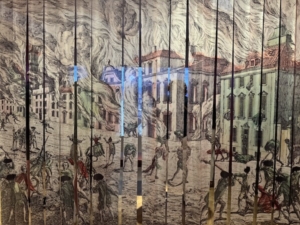
A copy of a late 1770s engraving designed to illustrate the look of New York City during the September 1776 Great Fire. In this case, the engraver’s image was transferred to strips of fabric that function as a flexi-door to the next room in “The Occupied City” exhibit at the Museum of the City of New York.

Above, one frame from a digitized film envisioning how Lower Manhattan probably looked after the 1776 Great Fire. This frame illustrates how the gutted Trinity Church may have appeared.
Below, a frame illustrating how Bowling Green may have looked and showing the empty pedestal where the statue of King George III had stood. The fire did not reach this green.
Bottom, a look at New York’s still-busy harbor, an area also not burned.
The five-minute film, seen in “The Occupied City” exhibit, is a customized adaptation of material from the “Assassin’s Creed” video games.
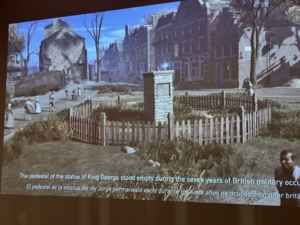
Throughout this exhibition at the Museum of the City of New York, there are options to hear narrators tell the stories in first-person style of real witnesses to Revolutionary Era New York. In one example, an actor speaks for Manuel Soto, a black fishermen, who describes ferrying the Continental Army from Brooklyn to safety in Manhattan. He says he and his comrades also were the boatmen who took George Washington and his men on their famous trip across the Delaware late the same year.
At the heart of it all
The exhibit’s heart is the section called “City Occupied: Seven Years Under Military Rule, 1776-1783.” One graph reveals that in 1776, the city’s population plummeted to around 5,000, down from an estimated 20,000 a year earlier, then climbed as loyalist and black refugees converged in the city seeking safety and, in the case of blacks, freedom. Some 50,000 lived in New York in the last year before the British left. The numbers include military personnel.
In those years, refugees headed to the burned-out parts of town, creating “Canvas Town,” so named because of the reliance on tent-like shelters. Thousands of colonial POWs — often troops captured elsewhere — were jammed into rickety boats floating in New York Harbor. An artist’s rendition of a packed POW ship is part of the exhibit. Half the prisoners died. Another exhibit item is a temperature chart for the exceptionally cold 1779-1780 winter, when the thermometer dipped to minus 22.
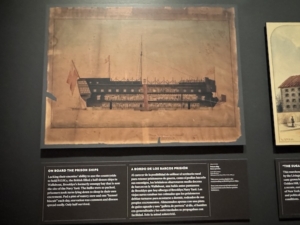
An artist’s illustration of a POW ship of the type that would have been seen in New York Harbor when the city was occupied during the American Revolution. The artist shows prisoners tightly packed on two deck levels.
Things had become quite grim, but eventually there were …
Happier days
In the exhibit’s subsection called “City of Hope: The First Emancipation 1783,” one display item is the “Inspection Roll of Negroes,” a huge book on loan from the National Archives, listing names, age, gender and other details about the former slaves and their families who were enabled to leave New York as free men and women. Those who could prove wartime service to the British were provided passports to other parts of the empire.
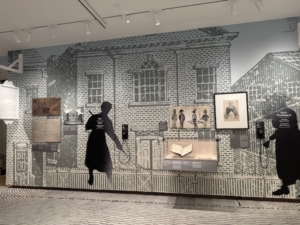
At “The Occupied City” exhibit, part of the display devoted to the 1783 emancipation of slaves who had served the British during the American Revolution and won passports to live free in other parts of the empire. The two figures who appear as silhouettes represent real people, one who escaped slavery and one who did not. Museum goers can pick up the single-cup headphones to hear each of the stories.
The show’s conclusion tells of a metropolis, ravaged both physically and economically, that was tapped to be the first capital of a new nation. One information board says this: “By the 1790s, New York had reemerged as the preeminent city of a new United States, with a thriving, international, diverse port.”
Displays in this exhibit area include a gown worn at a ball held to celebrate George Washington’s first presidential inauguration in 1789. Also, the copy of a 19th century painting showing Washington, while still the general, leading troops into the newly liberated city. The painting is both commanding and an idealized vision of the day, Nov. 25, 1783, when a defeated military was displaced. Washington’s triumphant march down the length of Manhattan is another popular vignette from the Revolutionary War that artists have depicted over and over.
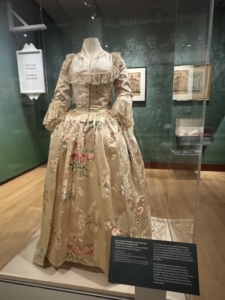
Seen in “The Occupied City” exhibit, a gown worn at an inauguration ball celebrating George Washington’s first presidential inauguration in 1789.
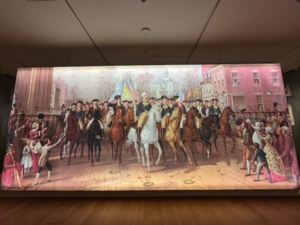
A huge reproduction of a 19th century lithograph called “Evacuation Day,” illustrating General Washington’s triumphant return to New York on Nov. 25, 1783, one of several popular Revolutionary Era subjects for artists.
Oh, and another surprise (for me, anyway): Until World War I, Nov. 25 was celebrated in New York as a holiday called Evacuation Day.
The exhibition,“The Occupied City: New York and the American Revolution” — to use its full formal title, will be on view at the Museum of the City of New York until May 1, 2027.
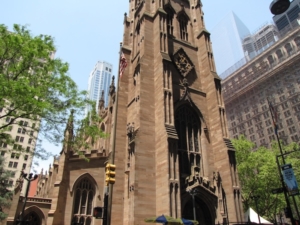
Trinity Church, on Broadway facing Wall Street, as it looks today. This is the third iteration of Trinity. The post-fire reconstruction was replaced in the mid-19th century after its roof gave way. The result is one of America’s finest examples of Neo-Gothic architecture.
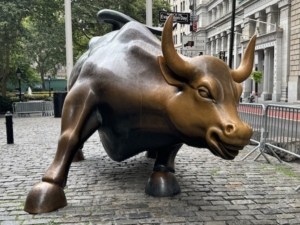
The sculpture called “Charging Bull,” or the “Bull of Wall Street,” located at the north fringes of Bowling Green in Lower Manhattan. To be precise, as of 2016, the tiny northern tip of Bowling Green, location of the bull, was renamed Evacuation Day Plaza. The signage is visible in this photo behind the bull’s left horn.
For more information about New York City, we offer at BestTripChoices.com the following, under the headline, No Rotten Apple here at https://besttripchoices.com/new-york-city-new-york/ This blog is by Nadine Godwin, BestTripChoices.com editorial director and contributor to the trade newspaper, Travel Weekly. She also is the author of “Travia: The Ultimate Book of Travel Trivia.” Except when otherwise indicated, photos also are by Nadine Godwin.